If AGVs are likened to the “laborers” of smart factories, then casters are the “shoes” on their feet. Whether these shoes fit properly directly impacts their ability to move steadily, swiftly, and over long distances.
Among numerous caster materials, polyurethane has become the mainstream choice for AGV casters due to its comprehensive advantages: high wear resistance, low noise, and floor protection. Yet, with the vast array of polyurethane wheel products on the market, how do you select the most suitable one? Today, we’ll discuss the five core points you must consider when selecting AGV polyurethane wheels.
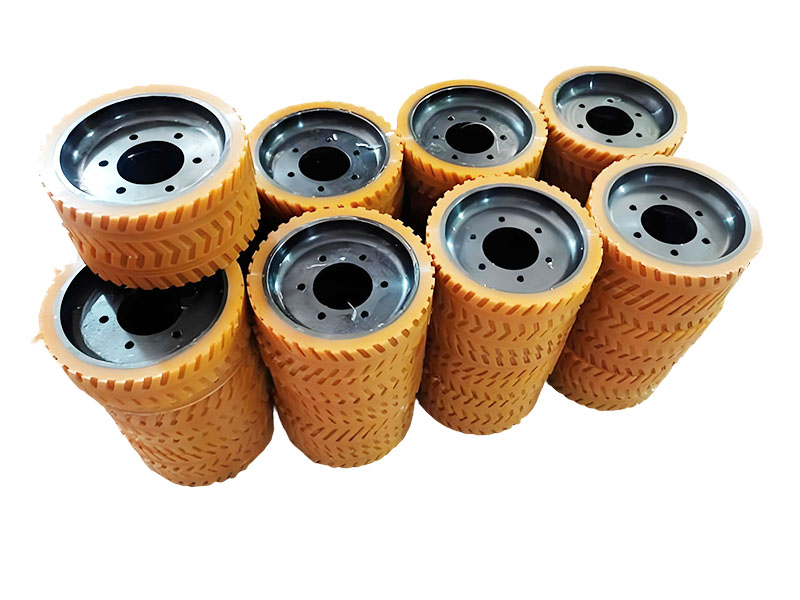
I. Load Capacity: Don’t Be Misled by “Numbers”
Load capacity is the primary selection criterion, yet many mistakenly assume that “as long as the wheel’s rated load is high enough, it’s sufficient.” The reality is far more complex.
Polyurethane wheels can achieve approximately double the load capacity per wheel compared to rubber wheels, supporting loads up to 6 tons in heavy-duty applications. However, during selection, you must calculate the dynamic safe load capacity, not the static limit.
Here’s a professional formula for reference: T = (E + Z) / n * S, where T is the required load capacity per wheel, E is the equipment’s self-weight, Z is the maximum load, n is the number of wheels, and S is the safety factor.
Selecting the safety factor S is crucial: for indoor smooth surfaces and low-speed operation, use 1.0-1.5; for outdoor work, obstacle-laden environments, or high-speed operation, increase it to 2.0-3.0. Remember, AGVs typically have four wheels, but due to uneven surfaces or center-of-gravity shifts, each wheel often bears only about one-third of the total load.
Tip: For an 8-hour daily operation scenario, it’s recommended to select wheels based on 80% of the rated load capacity. This approach can extend wheel lifespan to over 3 years.
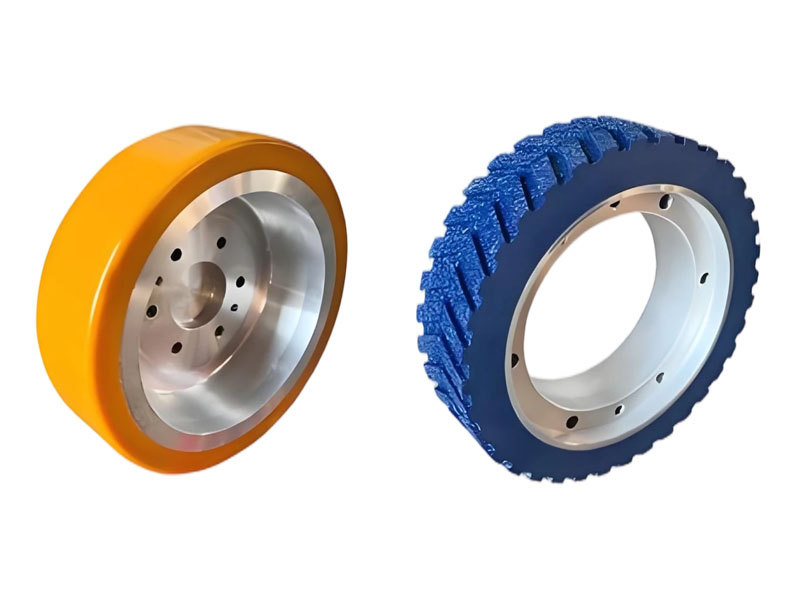
II. Wheel Core Material: Metal vs. Plastic – Choosing Wrong Can Lead to “Blowouts”
The wheel core is the skeleton of the wheel, and its selection directly impacts long-term operational reliability.
Never use plastic-core wheels! This is a taboo repeatedly emphasized within the industry. Plastic cores expand due to friction-generated heat during high-frequency operation. Mild cases cause deformation and precision loss, while severe cases result in wheel cracking and “blowouts,” triggering safety incidents.
In contrast, metal cores are the preferred choice. High-quality ductile iron or #45 steel cores, precision-cast and heat-treated, ensure structural rigidity and deformation resistance. For lightweight applications, aerospace-grade aluminum alloy is also a viable option.
In terms of manufacturing, high-quality polyurethane-coated wheels employ a “sandblasting + primer coating” process. This achieves molecular-level bonding between the polyurethane and metal core, yielding peel strength exceeding 15 kN/m and completely eliminating the risk of delamination.

III. Hardness and Elasticity: A Pair of Balanced Opposites
A core parameter for polyurethane wheels is hardness, typically measured in Shore A.
Higher hardness reduces rolling resistance, lowers energy consumption, and improves wear resistance. However, excessive hardness diminishes cushioning performance, weakens impact protection for surfaces, and increases vibration transmission. Lower hardness enhances elasticity, delivering superior shock absorption and noise reduction, but it also increases rolling resistance, raises energy consumption, and reduces wear resistance.
How to balance these trade-offs? The key lies in the application scenario:
Precision Electronics/Semiconductor Facilities:
High-hardness polyurethane (90A-95A) is recommended, offering both wear resistance and non-marking properties. It must meet ISO 14644-1 Class 5 cleanroom standards, ensuring no particle release during wear.
Logistics Sorting Centers: Frequent starts/stops at speeds exceeding 3m/s require formulations with moderate hardness (88A-92A) and low internal heat generation to prevent wheel softening from continuous operation.
Cold Storage Environments: Maintains elasticity and traction at -25°C using specialized low-temperature polyurethane formulations.
Interestingly, caster shape also impacts performance. Under load-bearing constraints, curved-surface casters exhibit lower rolling friction resistance than flat-surface casters, making them more suitable for high-speed, long-distance operation.
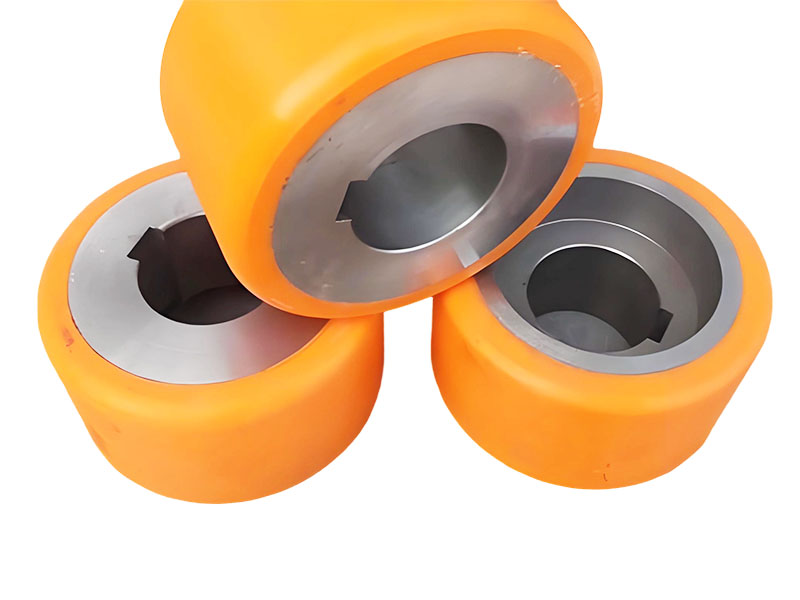
IV. Wear Resistance and Cleanliness: The Invisible Metrics
AGVs often require 24/7 continuous operation, where wear resistance directly determines maintenance costs and equipment utilization rates.
Polyurethane offers approximately 3-5 times the wear resistance of natural rubber. On concrete surfaces, its wear rate over 1,000 hours can be controlled below 0.1mm—significantly lower than rubber wheels’ 0.5mm rate. This translates to a service life of 2-3 years under normal conditions, and over 1.5 years in high-frequency applications.
For cleanrooms in semiconductor, pharmaceutical, and food industries, another critical metric is cleanliness compatibility. Conventional rubber wheels contain carbon black and filler oils, releasing particles that contaminate the environment during wear. Premium polyurethane wheels, however, utilize pure formulations that release no particles during wear, meeting Class 5 or higher cleanliness standards. Certain medical applications require food-grade polyurethane materials that withstand disinfectants with a swelling rate ≤3%.
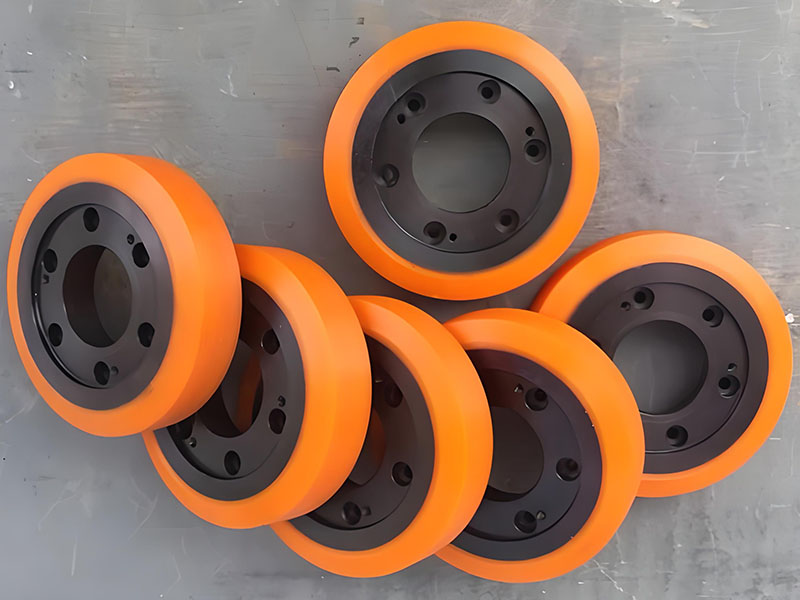
V. Adaptability to Special Environments: Details Determine Success
AGV operating environments vary greatly, necessitating consideration of “customized requirements” during selection.
High-Temperature Environments: Polyurethane typically withstands continuous operation up to 80°C (176°F) and short-term exposure up to 130°C (266°F). For AGVs operating in high-temperature workshops or near heat sources, heat-resistant polyurethane (e.g., NDI systems) must be selected to prevent wheel softening and deformation.
Chemical Environments: Automotive production lines and machining workshops often involve oil contamination and coolant leaks. Polyurethane inherently offers excellent resistance to oils and weak acids/alkalis, with stability far surpassing rubber wheels. However, specialized formulations are still required for strong acid or alkali environments.
Anti-static Requirements: In settings like electronics factories or gas stations, static sparks can cause catastrophic failures. Adding anti-static agents to polyurethane can control wheel resistance between 10⁴-10⁹Ω, eliminating static buildup.
Noise Control: Polyurethane wheels inherently offer noise reduction advantages, with operational noise levels controllable between 55-75 decibels—15-20 dB lower than metal wheels. For extreme quietness requirements, opt for structurally optimized silent-type polyurethane wheels featuring vibration-absorbing and shock-damping designs to further reduce noise.
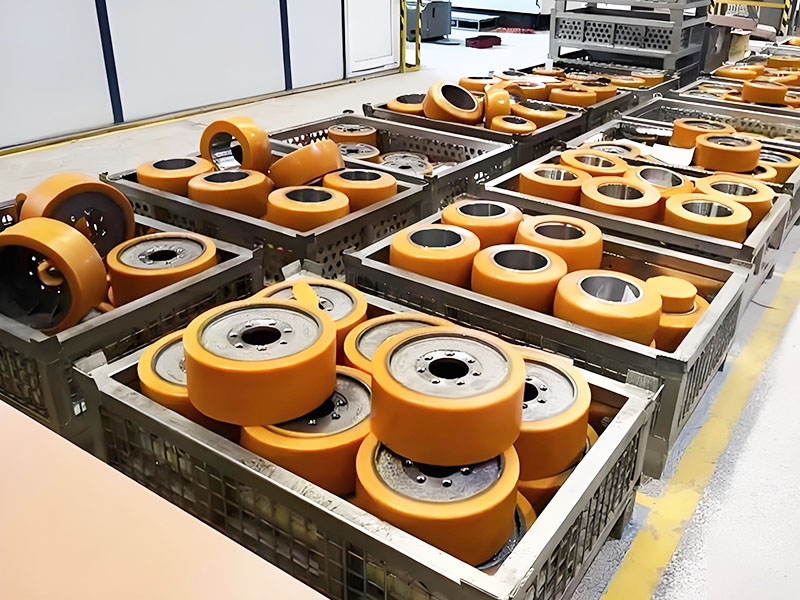
Selection Summary: Remember these three points
1. For heavy-duty high-speed applications, choose NDI/Vulkollan cast wheels: These premium polyurethane wheels feature low self-generated heat, high-temperature resistance, and fatigue resistance, suitable for high-intensity scenarios like stackers and heavy-duty AGVs.
2. For cleanrooms, select non-marking formulations: Ensure wear rate ≤0.1mm over 1,000 hours with zero particle release to meet cleanliness grade requirements.
3. For standard applications, choose 90A+ hardness + metal core: Balances wear resistance and energy efficiency, avoiding pitfalls of plastic-core wheels.
Finally, never forget: Regular inspection and maintenance. Even the finest polyurethane wheels require daily care—weekly cleaning of debris, quarterly wear checks, and avoiding prolonged overload operation. Only then can these “shoes” keep your AGVs moving further.
On the path to smart manufacturing, every detail matters. Choosing the right polyurethane wheels means equipping your AGV with footwear that delivers both speed and stability.


 Monday to Friday 8:00-17:00







 Telephone:
  Email:
  whatsApp: