In the quiet workshops of modern factories or bustling logistics hubs, tens of thousands of wheels operate silently every day. They bear the weight of heavy vehicle chassis or traverse precision tracks with relentless precision. While the focus often centers on equipment’s intricate design and motors’ powerful drive, it is the humble wheel—directly contacting the ground and bearing the entire load—that frequently determines the efficiency and safety of the entire system.
Polyurethane wheels, renowned for their exceptional properties like high wear resistance, heavy load capacity, and low noise, have long replaced traditional rubber wheels as the “standard configuration” in industrial applications. However, when faced with vastly different operating conditions, off-the-shelf components often fail to perfectly match requirements, making customization the optimal solution. Yet customization is far from simply providing dimensions—it’s a systematic engineering process involving materials science, mechanics, and manufacturing techniques. Today, we’ll discuss the four core considerations essential for custom polyurethane wheels.

I. Application Scenario Definition: The Origin of All Customization
Many people start by saying, “I need a 200mm diameter wheel.” Yet a clear description of the operating conditions is far more crucial than mere dimensions.
Before contacting suppliers, you must first clarify three core questions: What load capacity is required? What speed is needed? And what environment will it operate in?
Load capacity directly dictates polyurethane hardness selection and metal core strength. For instance, wheels for lightweight toolboxes and those for 10-ton heavy-duty AGVs feature vastly different internal structures. Heavy-duty applications may even require high-performance polyurethane materials like NDI systems (e.g., Covestro’s Vulkollan®). Though costlier, these excel under high-speed, heavy-load conditions.
Environmental factors are equally critical. Is your equipment in a standard-temperature warehouse or a chemical-solvent-filled electroplating workshop? Will it operate in a -30°C cold storage facility or endure outdoor exposure to sun and rain? Standard polyurethane resists strong acids and alkalis poorly. For specialized media environments, corrosion-resistant formulations are essential. Outdoor applications require UV-resistant aging protection. Only by clearly defining the application scenario can suppliers recommend the most suitable material system.
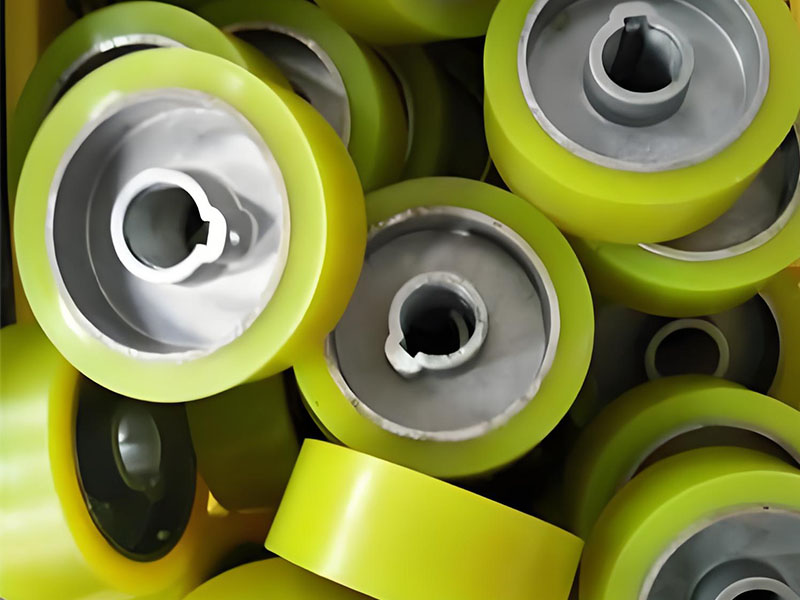
II. The “Dialectic” of Hardness: Harder Isn’t Always Better
Shore A hardness is the most frequently referenced parameter in customization, yet it stands not in isolation. Polyurethane wheel hardness typically ranges from 60A to 95A, or even higher.
A common misconception persists: many assume harder wheels offer superior wear resistance. In reality, a nuanced “dialectic” exists between hardness and performance. Softer wheels (e.g., 60A-75A) exhibit excellent deformation capacity and strong grip, conforming to uneven surfaces for exceptional shock absorption and noise reduction. They also protect epoxy floors from scratches, making them ideal for precision equipment or indoor applications. Harder wheels (e.g., 80A-95A) feature lower rolling resistance, higher load capacity, and typically superior wear resistance. They are ideal for concrete surfaces or heavy-duty, long-distance transport.
Additionally, a crucial yet often overlooked metric is rebound elasticity. High-rebound formulations reduce energy consumption, making equipment easier to push, while low-rebound formulations effectively suppress vibrations. During customization discussions, communicate whether your primary requirement is “silence” or “effort reduction” to guide suppliers in fine-tuning the balance between hardness and elasticity through formulation adjustments.
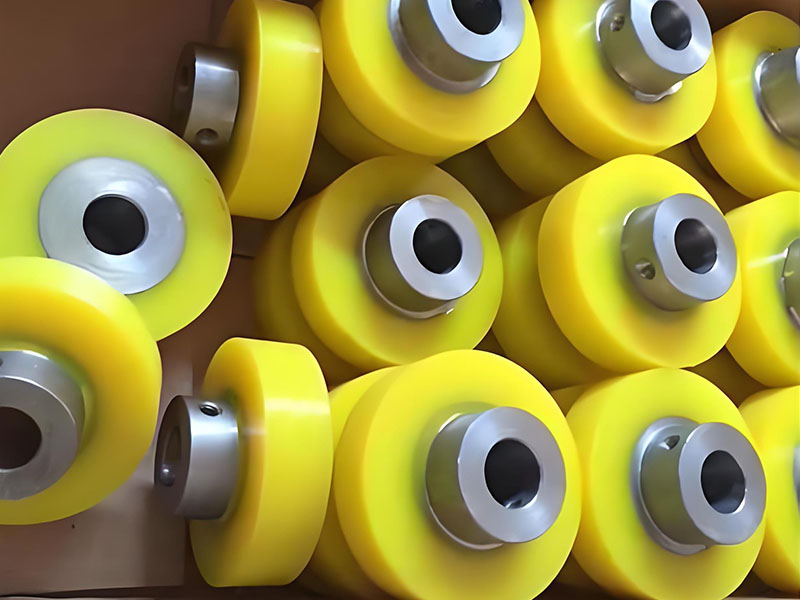
III. The Invisible “Bonding Strength”: Delamination Is the Greatest Nightmare
For polyurethane-coated wheels, the most common failure mode isn’t wear-through but “delamination”—where the polyurethane layer separates from the metal core. This bonding strength is the most hidden yet critical aspect of the customization process.
High-quality customization demands meticulous core pretreatment. Professional manufacturers first sandblast or chemically etch the metal core to remove oil residues while increasing surface roughness, enabling the adhesive to embed firmly. Subsequently, a specialized adhesive is applied and cured in an oven before proceeding to the casting stage.
During inspection, beyond visual checks for bubbles or cracks, prioritize suppliers who provide bonding strength test reports. For high-speed wheels (e.g., shuttle cart drive wheels), dynamic balancing tests are indispensable. An unbalanced wheel not only causes equipment vibration and noise but also accelerates rubber layer delamination due to periodic impact forces. An excellent custom wheel should achieve a seamless integration of soft and hard components.
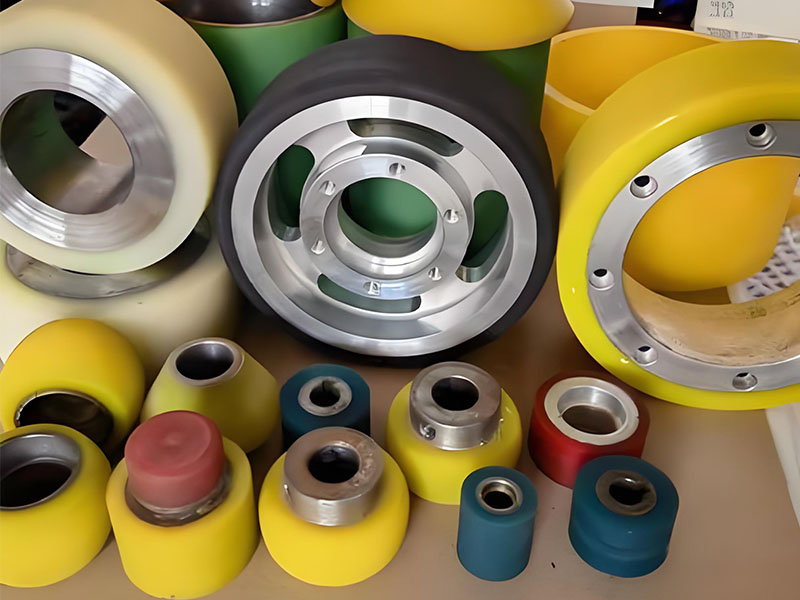
IV. The Art of Communication: Information Beyond Drawings
Customization is not a one-way directive but a two-way dialogue. When requesting quotes from manufacturers, beyond providing a CAD drawing with outer diameter, width, and bore specifications, several “soft details” can help secure a more precise solution:
1. Floor Conditions: Is it smooth epoxy flooring or rough concrete? Are there metal shavings or debris on the surface? (For specific surfaces, different patterns or grooves can be designed to enhance slip resistance).
2. Operating Mode: Is it primarily straight-line movement, or does it require frequent turning? When turning, is it pivoting in place or rolling while turning? (This affects the wheel’s friction resistance design).
3. Special Requirements: Is anti-static capability needed (e.g., for electronics factories)? Is food-grade certification required? Are there specific color requirements (e.g., color-coding for departments)?
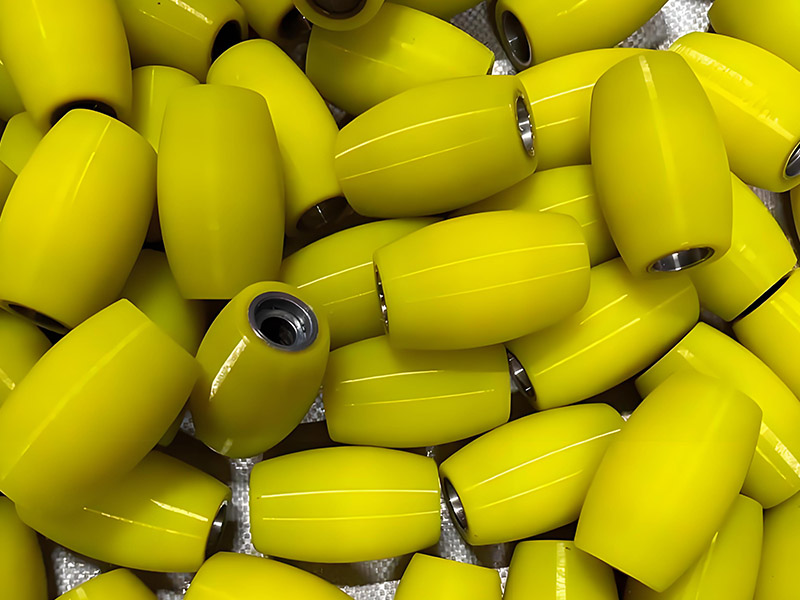
Conclusion
Though small, polyurethane wheels serve as the “shoes” connecting industrial civilization to the ground. Just as ill-fitting shoes make walking difficult, a poorly designed wheel can significantly reduce the efficiency of an entire production line.
The next time you need custom polyurethane wheels, take extra time to discuss your application scenarios and genuine pain points with your supplier. Focus on these four key elements—material, hardness, manufacturing process, and testing—and you will surely find the perfect solution that can bear immense weight while turning with precision. After all, in this era of pursuing ultimate efficiency, every detail deserves careful attention.


 Monday to Friday 8:00-17:00







 Telephone:
  Email:
  whatsApp: