To meet diverse customer demands across industries, YALIDE continuously develops and refines material technologies while expanding application projects to address growing market needs and challenges. For years, their engineers have collaborated closely with renowned Chinese university materials laboratories to develop and compound materials, creating industrial polyurethane wheel materials such as NDIthane, Loathane, Rollthane, Fricthane, Electhane, and MDIthane. With such a diverse range of polyurethane wheel materials, how should one make a selection? We can evaluate them based on four dimensions:
First: Load Capacity of Industrial Polyurethane Wheels
The required load capacity of industrial polyurethane wheels is a critical factor in material selection. Load capacity can also be converted from pressure, torque, or clamping force. Speed ranges from 4 km/h to 16 km/h serve as a material selection criterion. Typically, industrial polyurethane wheel manufacturers maintain material databases detailing the load capacity of different materials.
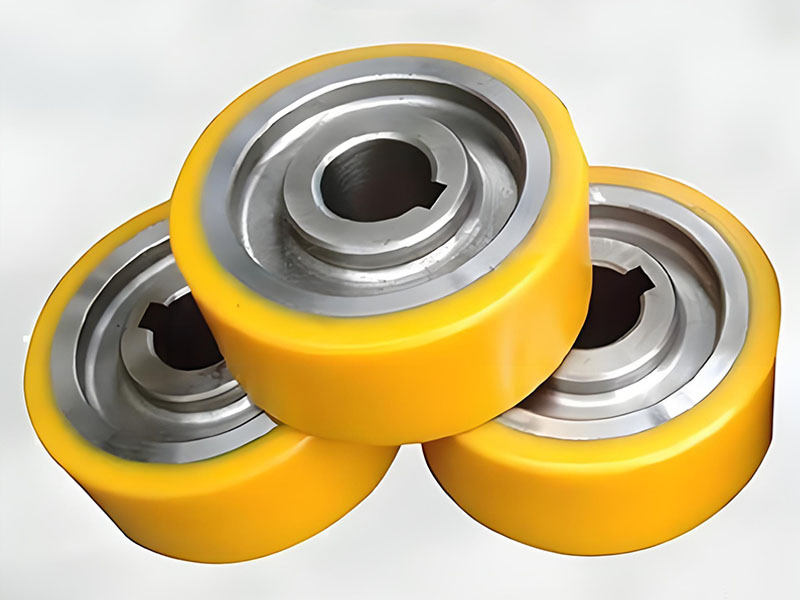
When selecting material load capacity, we generally recommend a 10–20% margin. For example, if your required load capacity is 1000kg, the selected material should have a minimum load capacity of 1100–1200kg.
Second: Driving Force of Industrial Polyurethane Wheels
Whether applied on floors, metal rails, drive drums, or rubber tracks, the driving force generated by motors is transmitted to the wheels to produce propulsion, braking force, or steering force. This requires the wheels to possess adequate adhesion. Polyurethane material exhibits elastomer hysteresis, generating driving force while also creating rolling resistance. Additionally, internal heat is generated during rolling, affecting wheel performance, wear, and lifespan.
Third: Friction of Industrial Polyurethane Wheels
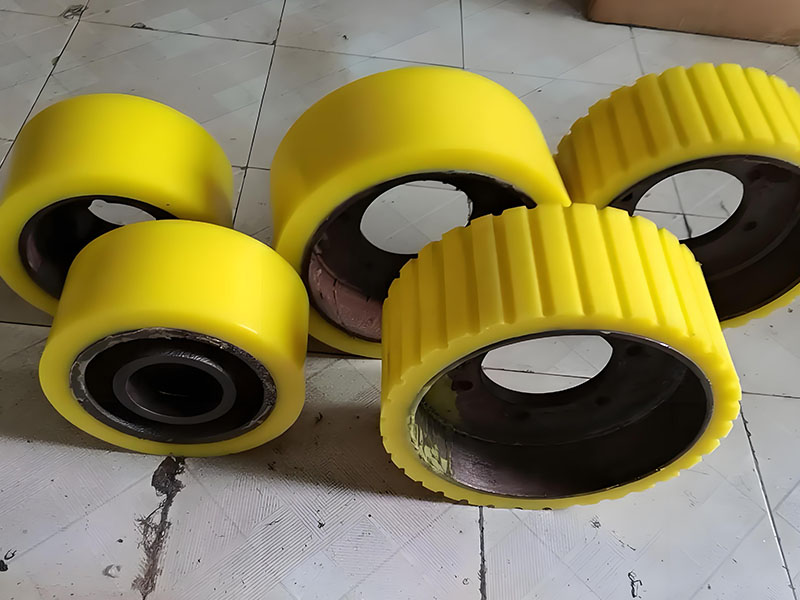
Friction or the coefficient of friction is fundamental to generating driving force. The coefficient of friction between polyurethane material and surfaces—such as metal rails, drums, or rubber tracks—serves as a critical indicator of wheel performance. This coefficient not only determines the magnitude of driving force but also influences wheel wear and lifespan. Selecting an appropriate coefficient of friction is a key consideration in wheel design.
Fourth: Speed of Industrial Polyurethane Wheels
Polyurethane wheels exhibit viscoelastic hysteresis inherent to elastomers. During rolling, molecular friction within the polyurethane material generates endogenous heat and microphase separation. This can cause molecular chain breakage in the polyurethane tread, leading to melting and degradation. Under certain loads, the wheel’s rolling speed is a key factor inducing endogenous heat and microphase separation. Higher speeds demand greater thermal resistance from the material.
Cast polyurethane elastomers find extensive applications wherever maximum abrasion resistance, mechanical strength, and physical toughness are required. This includes various molded components, high-quality polyurethane wheels, polyurethane rollers, and semi-finished polyurethane products requiring further machining. These parts can be produced through our automated batch manufacturing or manually in small batches.

Yalide recommends industrial polyurethane wheel material: NDIthane
The premier choice for superior elastomers: NDIthane has gained widespread adoption across demanding industries due to its exceptional mechanical properties, even gradually replacing many steel and rubber products. It delivers an outstanding performance profile, making it the ideal solution for diverse specialized and demanding applications. It exhibits dynamic stress resistance, high abrasion resistance, minimal permanent deformation, high resilience, excellent resistance to UV, ozone, and oils, low temperature dependency, and maintains high impact flexibility and tear resistance even under harsh conditions.
Exceptional heat resistance and minimal energy loss: Polyurethane wheels based on NDIthane exhibit outstanding heat resistance. Between -10°C and 120°C, the tread’s shear modulus and damping characteristics remain largely consistent. Additionally, deformation during loading and unloading is minimal (as shown in the figure above), demonstrating the extremely low energy loss of NDIthane polyurethane wheels.


 Monday to Friday 8:00-17:00
 YALIDE >
News Content>Industry News> Four Dimensions for Selecting Industrial Polyurethane Wheel Materials
YALIDE >
News Content>Industry News> Four Dimensions for Selecting Industrial Polyurethane Wheel Materials 





 Telephone:
  Email:
  whatsApp: