Common wheel tread materials available on the market include PU, PVC, PP, PA, TPR, TPE, and rubber. Wheels made from different tread materials are suited for varying operational requirements, cost budgets, and performance preferences. Below is a systematic analysis of the core advantages and disadvantages of these seven tread materials—PU, PVC, PP, PA, TPR, TPE, and rubber—along with their applicable scenarios and selection recommendations.
PU Material Wheels
PU, or polyurethane, is a polymer material and one of the most common wheel tread materials on the market today. It possesses highly distinctive characteristics: exceptional wear resistance, tear resistance, and extended service life; excellent elasticity, shock absorption, noise reduction, and smooth rolling; strong load-bearing capacity and impact resistance; superior oil and chemical resistance compared to standard rubber; and customizable hardness (Shore A 60–98). Certain specially formulated polyurethane wheels also deliver outstanding performance in conductivity and anti-static properties. Generally, PU wheels are suitable for logistics forklifts, AGVs, mining equipment, warehouse shelving casters, medical equipment, industrial carts, and similar applications.
However, standard polyurethane generally has limited high-temperature resistance (long-term ≤80°C, short-term ≤100°C) and tends to harden and become brittle below -20°C. Its production cost is higher than PVC/PP/TPR. Due to these characteristics, PU wheels are not recommended for environments involving high-temperature baking, extreme cold outdoors, or prolonged immersion in strong acids/alkalis—except for certain specially formulated polyurethane materials.

PVC Material Wheels
PVC is a polymer material formed through the polymerization of vinyl chloride monomers, ranking among the five major general-purpose plastics. Consequently, PVC exhibits distinct characteristics: extremely low cost with high cost-effectiveness; Excellent weather resistance, aging resistance, and corrosion resistance; smooth surface, easy to clean, available in colored/transparent options; good electrical insulation properties. Consequently, wheels with PVC treads are typically used in light-duty casters, furniture casters, supermarket shopping carts, and indoor light equipment.
However, it also has inherent drawbacks: poor elasticity and weak shock absorption; average wear resistance, prone to deformation and cracking under prolonged heavy loads; Significant low-temperature brittleness, prone to fracture below -10°C; Contains plasticizers that may leach out under prolonged high temperatures. These limitations preclude their use in heavy-duty applications, high-frequency impact scenarios, low-temperature outdoor environments, or food contact (non-food grade).
PP Material Wheels
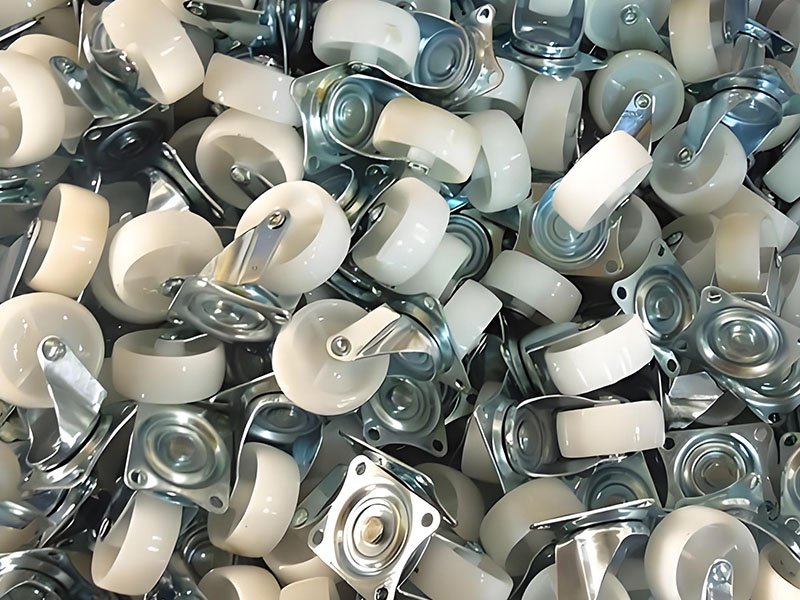
PP material is a semi-crystalline thermoplastic polymer produced through the addition polymerization of propylene monomers, ranking among the lightest plastics. Its characteristics are distinct: low density (0.9 g/cm³), lightweight; exceptional chemical resistance (acid, alkali, solvent resistant); non-toxic, odorless, and food-grade compliant; low cost with high injection molding efficiency. Thus, it is suitable for applications like food machinery casters, laboratory equipment, chemical container casters, and lightweight storage bin casters.
However, PP material suffers from several drawbacks: high rigidity with poor elasticity, no shock absorption, high noise levels; poor wear resistance, prone to abrasion and pilling under prolonged friction; weak low-temperature impact resistance (becomes brittle below -10°C); and limited high-temperature tolerance (long-term use ≤80°C). These limitations make PP wheels unsuitable for heavy-duty applications, high-frequency movement, scenarios requiring shock absorption and noise reduction, or low-temperature outdoor use.
PA Material Wheels
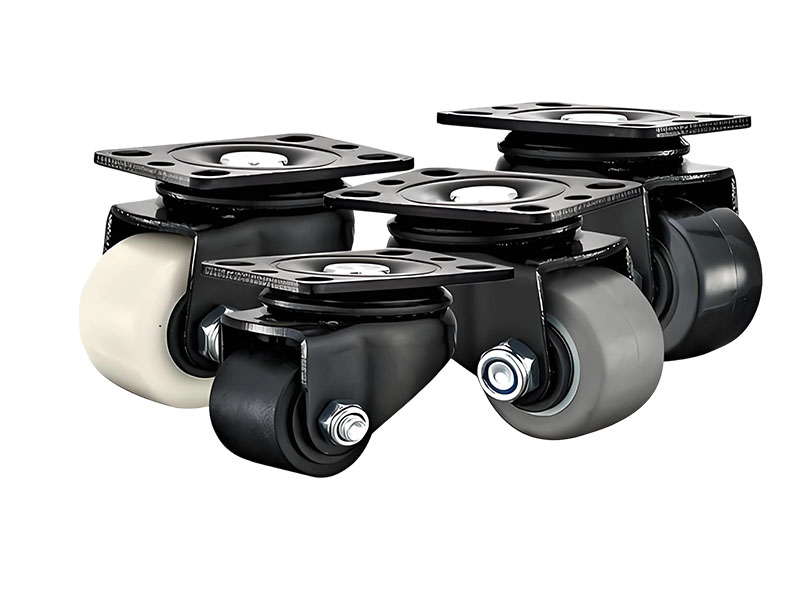
PA material, commonly known as nylon or polyamide, includes PA6/PA66 variants. It offers high strength, rigidity, and load-bearing capacity; superior wear resistance compared to PP/PVC with excellent self-lubrication; good oil resistance and corrosion resistance; and high-temperature tolerance (long-term ≤120°C). It is typically used in heavy-duty equipment casters, textile machinery, mining equipment, and high-temperature workshop machinery.
However, PA material exhibits high water absorption, poor dimensional stability in humid environments, low elasticity, weak shock absorption, and high noise levels. Its impact resistance decreases below -20°C. Its cost is higher than PP/PVC but lower than PU. It is unsuitable for high-humidity/underwater environments, applications requiring shock absorption and noise reduction, or extreme cold outdoor conditions.
TPR Material Wheels
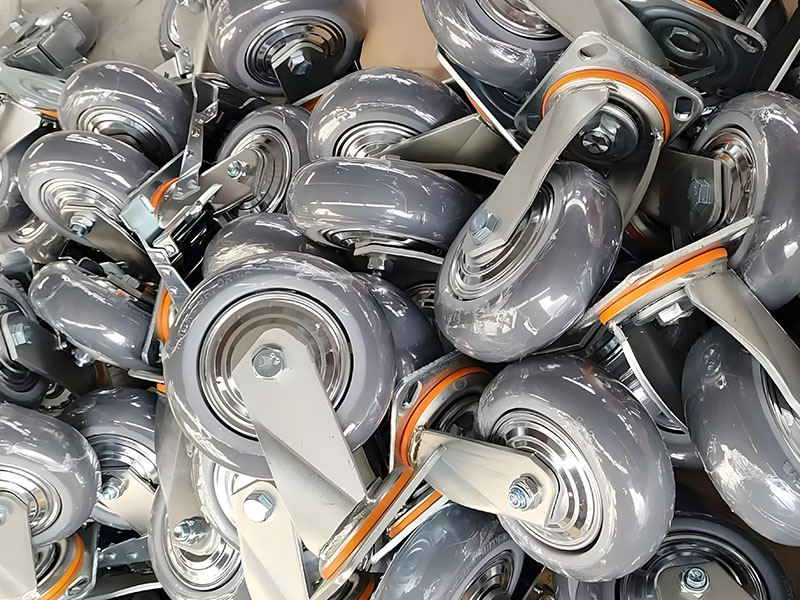
TPR is a thermoplastic rubber material offering excellent elasticity, shock absorption, noise reduction, and walking comfort. It maintains good low-temperature toughness (remaining elastic at -40°C), is injection-moldable, and features high processing efficiency, environmental friendliness, non-toxicity, and recyclability. Applications include toy casters, medical carts, indoor light equipment, and low-temperature environment casters.
However, TPR exhibits weaker abrasion resistance and tear strength compared to PU, limited high-temperature tolerance (long-term ≤70°C), restricted load capacity (prone to deformation under heavy loads), and average oil/chemical resistance. Consequently, it is unsuitable for heavy-duty, high-temperature, or oil/chemically corrosive applications.
TPE Material Wheels
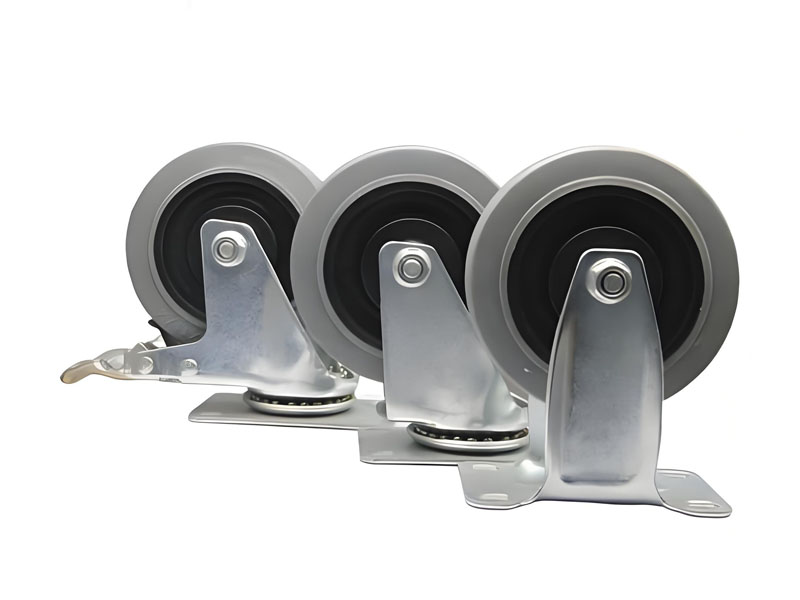
TPE is also a thermoplastic elastomer, considered an upgraded version of TPR. TPE offers elasticity comparable to rubber, excellent shock absorption and noise reduction, outstanding low-temperature performance (-60°C to 80°C usable), environmental friendliness, non-toxicity, recyclability, high processing efficiency, good surface tactility, and compatibility with hard plastics. Consequently, it is commonly used in high-end medical equipment, baby strollers, smart home casters, and outdoor lightweight equipment.
However, TPE material remains inferior to PU in abrasion resistance and tear strength, carries a higher cost than TPR/PVC, and is prone to aging under prolonged high temperatures (>80℃) with only moderate oil resistance. Consequently, TPE is unsuitable for applications involving heavy loads, high-frequency impacts, or high-temperature/oily environments.
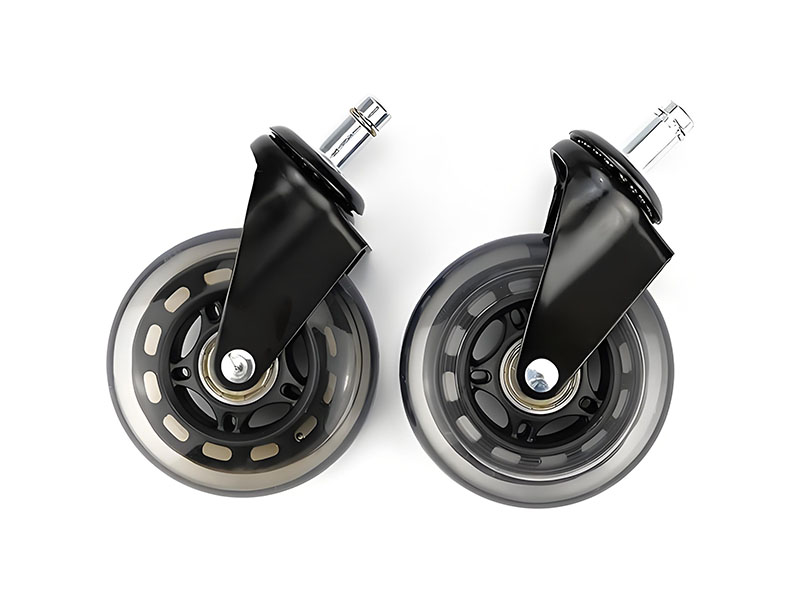
Rubber Material
Rubber materials are typically natural rubber, nitrile rubber, or neoprene. These are highly elastic polymer materials capable of reversible deformation. They exhibit elasticity at room temperature, undergo significant deformation under minimal external force, and return to their original shape once the force is removed. Their characteristics are distinct: exceptional elasticity with superior shock absorption and noise reduction; strong grip and outstanding slip resistance; fatigue resistance and impact resistance. Natural rubber is environmentally friendly, nitrile offers oil resistance, and neoprene provides weather resistance. Consequently, these rubber wheels are commonly used in construction machinery, automotive tires, outdoor equipment, shock-absorbing casters, and anti-slip casters.
However, rubber exhibits poorer wear resistance than PU, is prone to aging (especially natural rubber), and carries higher costs than PVC/PP, with certain specialty rubbers being particularly expensive. Additionally, natural rubber has poor oil and chemical resistance, and some rubbers become brittle at low temperatures (below -30°C). These limitations make rubber wheels less suitable for certain applications like construction machinery, automotive tires, outdoor equipment, shock-absorbing casters, and anti-slip casters.
Recommendation Summary
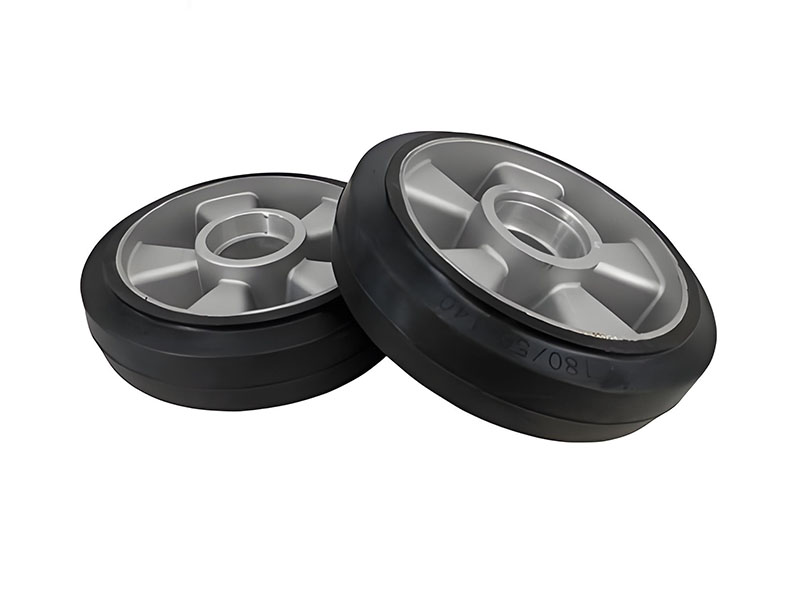
PU wheels are the mainstream material for industrial casters, particularly suited for heavy-duty, high-frequency applications like logistics and mining. Their high-temperature and low-temperature performance can be enhanced through formulation optimization (e.g., adding wear-resistant agents or anti-aging agents). Material composites are a common solution: PU-coated iron cores, TPE-coated nylon, or rubber-coated metal combine elasticity with strength. Stainless steel wheels often incorporate rubber/PU cushioning layers to reduce noise. Wheels with different tread materials possess distinct advantages and disadvantages. Select the most suitable option by comprehensively evaluating your specific operating conditions and budget.


 Monday to Friday 8:00-17:00
 YALIDE >
News Content>Industry News> How to choose wheel tread materials like PU, PVC, PP, PA, or rubber?
YALIDE >
News Content>Industry News> How to choose wheel tread materials like PU, PVC, PP, PA, or rubber? 





 Telephone:
  Email:
  whatsApp: