As core mobility components for industrial vehicles, polyurethane wheels are often categorized into drive wheels, load-bearing wheels, auxiliary wheels, and balancing wheels due to differences in force application, performance emphasis, structural design, and application scenarios. Due to their highly similar appearance, many unfamiliar individuals struggle to accurately distinguish them. Below is a brief analysis:
Drive Wheels
Drive wheels are the only polyurethane wheels that transmit torque. Their core function is to convert motor power into forward/reverse propulsion for the equipment, rather than merely bearing weight. As the primary power source for forklift movement, many drive wheels feature anti-slip tread patterns or high-friction textured surfaces to enhance ground grip and prevent slippage (especially on smooth surfaces or inclines).
Drive wheels made of polyurethane elastomer must meet essential performance requirements. Subjected to prolonged torque and friction, they are prone to tread chunking and cracking. Therefore, the polyurethane elastomer for drive wheels must meet standards for tear resistance and dynamic abrasion resistance. Based on mounting methods, drive wheels are categorized into keyway-type, spline-type, and flange-type drive wheels. Directly connected to the motor shaft or transmission mechanism, drive wheels require precise concentricity to prevent eccentric wear.
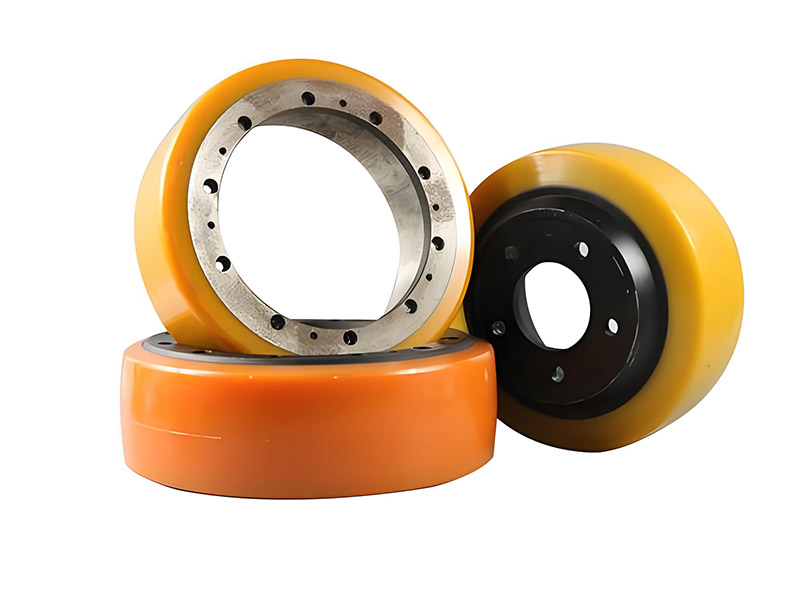
Load-bearing Wheels
Load-bearing wheels serve as the primary “load-bearing responsibility” for industrial vehicles. Designed exclusively for pure load-bearing, they transmit almost no torque. The entire weight of the equipment rests upon them, making them the core wheel components for heavy-duty machinery. Load-bearing wheels typically feature smooth, flat treads to increase ground contact area, distribute pressure, and reduce localized tread deformation.
Core requirements for load-bearing wheels include pressure resistance and resistance to permanent deformation under static/dynamic loads. Polyurethane hardness is typically selected between 85A-95A (high hardness). In some ultra-heavy-duty applications, composite structures combining polyurethane and metal are used. Load-bearing wheels feature thicker treads, with hubs made of thick-walled metal (steel/cast iron) and reinforced axles to prevent hub deformation and axle breakage under heavy loads.
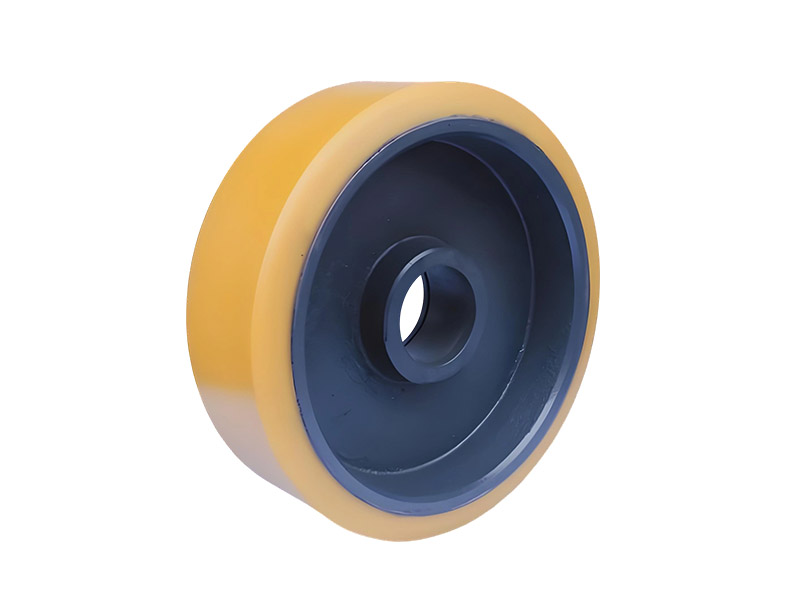
Balancing Wheels
Balancing wheels primarily counteract uneven loads and prevent tipping during industrial vehicle operation. They are typically used in conjunction with main wheels (drive/load-bearing wheels), often symmetrically arranged on both sides or the bottom of the equipment. Many people categorize stabilizer wheels and auxiliary wheels together. Since their sole function is to counteract uneven loads, stabilizer wheels typically feature narrow treads and small diameters. They require minimal contact area, needing only to provide basic support.
Balance wheels are usually mounted at the edges or corners of equipment and do not necessarily maintain constant ground contact (e.g., rear balance wheels on forklifts). However, they must form a stable support triangle with the main wheels. Examples include rear balance wheels on wheelchairs and side wheels on the bottom of handcarts. These wheels typically use medium-hardness, high-elasticity polyurethane material.
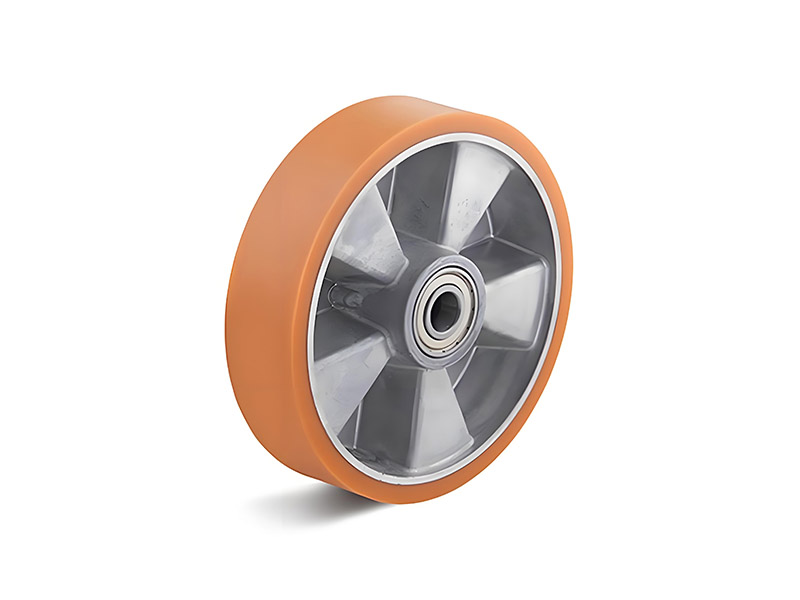
Auxiliary Wheels
Auxiliary wheels primarily follow the movement of the main wheels. They lack independent power or steering assistance, rotating freely in the direction of the equipment’s motion. Some incorporate swivel mechanisms to enhance the equipment’s steering flexibility. Given these characteristics, auxiliary wheels feature treaded surfaces for lightweight construction and reduced rolling resistance. Swivel models typically combine a swivel ball with a wheel body. Core requirements include low rolling resistance and impact resistance, as auxiliary wheels frequently encounter ground obstacles (e.g., steps, gaps) necessitating tread durability.
Auxiliary wheels are commonly found on conveyor lines, rail vehicles, or as support points for complex AGVs. Most incorporate universal joints/steering brackets for 360° rotation, serving as standard equipment on office chairs and logistics carts. Design emphasizes dimensional precision and smooth operation; though non-drive and non-load-bearing, they must remain durable. When operating on tracks or specific paths, they require excellent tracking performance.
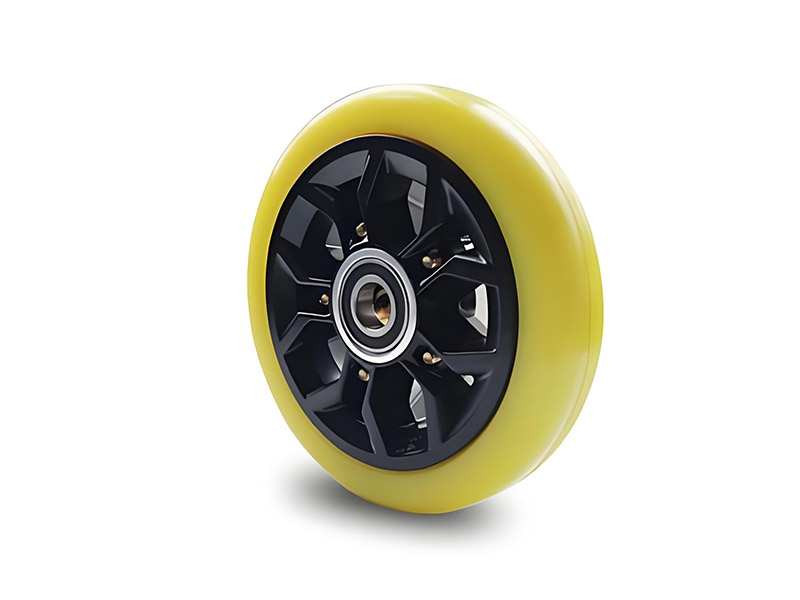
Steering Wheels / Swivel Casters
Swivel casters/universal casters primarily enable flexible steering in industrial vehicles, typically rotating 360 degrees. These polyurethane wheels require excellent resistance to lateral shear and uneven wear, as the wheel surface承受s significant lateral friction during steering. They must offer flexible rotation with low turning resistance for effortless maneuvering. Polyurethane elastomers provide good elasticity and shock absorption. Since some steering wheels also bear loads, they must absorb ground impacts.
Steering wheels/swivel casters are generally supplied with steering bracket (caster) assemblies. Due to frequent maneuvering, their flanges require reinforced design, accelerating wear on textile flanges. Steering wheels/swivel casters typically have slightly lower hardness than load-bearing wheels to enhance traction and shock absorption.

Summary
As manufacturers, clearly explaining these differences to customers and recommending matching wheel combinations and customized formulations based on their equipment’s specific operating conditions (e.g., load distribution, speed, ground conditions, precision requirements) is key to delivering high-value-added solutions.
Dongguan Yalide Technology Co., Ltd. is a National High-Tech Enterprise with years of expertise in polyurethane and rubber material development, molding, manufacturing, and testing. The company focuses on polymer material technology R&D, combining diverse production processes with experienced technical personnel to develop and manufacture various polyurethane overmolded wheels, polyurethane rollers, rubber rollers, overmolded shafts, metal shafts, and other cylindrical products. We provide customers with complete system solutions for roller/shaft/wheel products.


 Monday to Friday 8:00-17:00
 YALIDE >
News Content>Industry News> How to distinguish between different categories of polyurethane wheels?
YALIDE >
News Content>Industry News> How to distinguish between different categories of polyurethane wheels? 





 Telephone:
  Email:
  whatsApp: