In the era of Industry 4.0 and smart manufacturing, polyurethane casters are redefining mobility standards for various equipment with their outstanding comprehensive performance. As an advanced polymer material bridging traditional rubber and engineering plastics, polyurethane precisely meets stringent requirements across diverse industrial applications through scientific formulation design and process optimization.
Classified by Load-Bearing Structure
Lightweight Precision Casters: Typically supporting loads between 50-200kg, these lightweight polyurethane casters are primarily used in laboratory equipment, electronic assembly carts, precision instrument platforms, etc. Lightweight polyurethane casters range in diameter from 80-125mm, featuring ultra-low rolling resistance (coefficient ≤0.015) and quiet operation (≤55dB).
Medium-duty industrial casters: Polyurethane casters with load capacities between 200-800kg. Primarily used in logistics trolleys, production line fixtures, and medical equipment. Medium-duty polyurethane casters range in diameter from 125-200mm and typically feature dual-row ball bearings with dynamic balance design.
Heavy-duty engineering casters: These polyurethane casters handle loads from 800-3000kg. Primarily used in port equipment, heavy machinery, and mining vehicles, they feature diameters of 200-400mm with a triple-layer reinforced structure and impact-resistant compound.
Super-heavy-duty specialty casters: These polyurethane casters can handle loads of 3-10 tons. Primarily used in aerospace assembly, shipbuilding, power engineering, and other large-scale machinery, they feature diameters of 400-600mm, embedded steel frames, and multi-wheel synchronization systems.
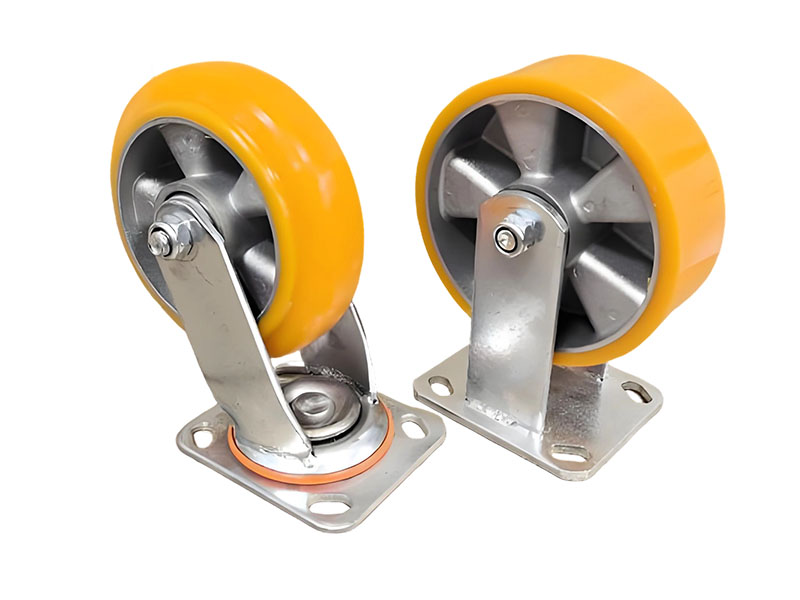
Classified by Functional Characteristics
Conductive/Anti-Static Series:
Surface resistance adjustable between 10³–10⁹ Ω. Due to their specialized properties, these are typically used in semiconductor workshops (10⁶–10⁸ Ω) and chemical explosion-proof zones (10³–10⁵ Ω). Employing conductive/anti-static polyurethane casters in semiconductor workshops and wafer fabrication plants significantly reduces static-related failure rates.
High/Low Temperature Resistance Series:
These casters utilize specialized formulations, operating within -60°C to +150°C (-76°F to 310°F) (special formulations extend to +180°C/356°F). This series incorporates innovative technology with low-temperature anti-brittleness modifiers and high-temperature anti-softening additives. These casters are widely used in cold chain logistics (maintaining elasticity at -40°C) and foundries (resisting instantaneous high-temperature spatter).
Ultra-Quiet Non-Marking Series:
Manufactured with a special formulation, achieving a noise level ≤58dB (measured 1 meter from the source). The non-marking effect achieves zero pressure marks, zero staining, and zero chemical contamination. Due to these properties, this series is extensively used in hospital surgical equipment, museum exhibit carts, and data center server racks.
Chemical-Resistant Series:
These polyurethane casters withstand pH levels from 1 to 13, making them suitable for various organic solvents within this range. Typically featuring fluorinated surface treatment, these casters are extensively used in electroplating production lines, chemical laboratories, and wastewater treatment equipment.

In-Depth Analysis of Polyurethane Caster Industry Applications
Smart Manufacturing and Automation
In smart factories, polyurethane casters serve as critical infrastructure: AGV navigation precision with diameter tolerances controlled at ±0.1mm ensures laser positioning accuracy. They enable flexible production line reconfiguration, rapidly reorganizing production units while reducing pushing/pulling force by 35%. Serving as data collection carriers, they integrate RFID and sensors for end-to-end material tracking. For instance, Hyundai Motor’s smart automotive parts factory reduced production line reconfiguration time from 8 hours to 1.5 hours and enhanced equipment mobility precision to ±0.3mm after adopting specialized polyurethane casters.
Healthcare Sector
Specialized technical solutions address healthcare’s unique demands: Sterile environment compatibility verified through EO sterilization, compliant with ISO 13485 standards. Drug compatibility confirmed by USP Class VI biocompatibility testing. Ergonomic optimization with ≤15N pushing force (meeting international accessibility standards). Actual usage data from tertiary hospitals shows: Professional medical casters reduce equipment movement noise by 70% and decrease nurse occupational injuries by 45%.
Modern Logistics Systems
End-to-end applications from warehousing to distribution: High-bay shuttle carts: Wear resistance index ≥150, ensuring 3 years of maintenance-free operation.Cold chain delivery vehicles: Elasticity retention ≥90% at -25°C.Express sorting lines: Impact-resistant formula withstands 60 collisions per minute. Current e-commerce regional centers using polyurethane casters have seen equipment failure rates drop by 68% and energy consumption decrease by 22%.

Specialized Industrial Applications
Technological innovation for extreme conditions: Mining machinery with tear resistance ≥120kN/m, withstanding continuous gravel impact. Offshore engineering with salt spray corrosion resistance, passing 2000-hour salt spray testing. Food processing using FDA-certified materials, safe for direct food contact.
Five Key Dimensions for Selection Decisions
1. Load Analysis Dimension: Static load vs. dynamic load, impact load frequency and intensity, load distribution in multi-wheel systems.
2. Surface Compatibility Dimension: Surface material and hardness (Mohs hardness measurement), surface flatness (≤2mm measured with 3m straightedge), surface coating type and thickness.
3. Environmental Tolerance Dimension: Temperature/humidity range, chemical exposure conditions, cleanliness grade requirements.
4. Operational Parameter Dimension: Average daily travel distance, maximum operating speed, turning frequency and angle.
5. Compliance Certification Dimension: Industry-specific standards (medical, food, explosion-proof, etc.), international certification requirements (CE, UL, FDA, etc.), corporate quality management systems.
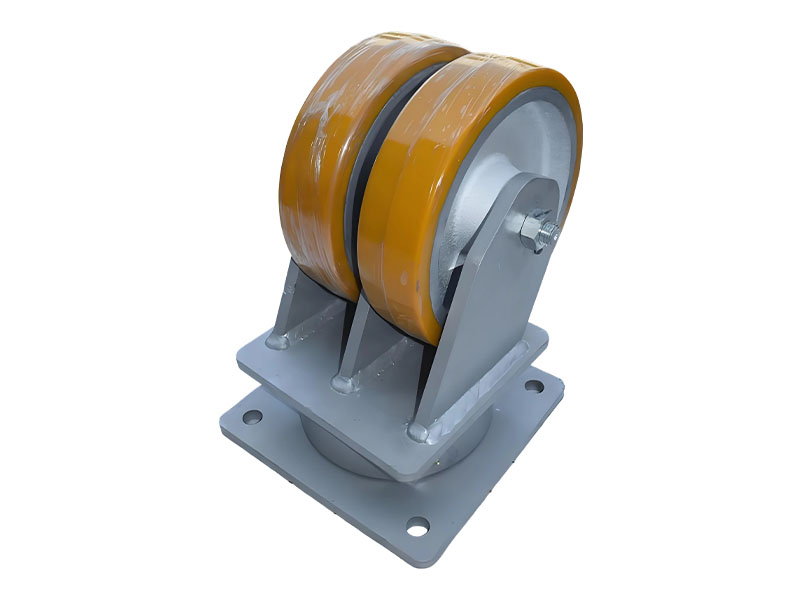
YALIDE Polyurethane Casters Manufacturer
Choosing polyurethane casters fundamentally means selecting a comprehensive mobility solution. They are not merely the “walking components” of equipment but a systemic engineering solution connecting equipment performance, floor protection, operational efficiency, and safety standards. From lightweight lab carts to heavy-duty port machinery, from sterile medical environments to harsh industrial sites, polyurethane casters are redefining mobility standards across industries through profound innovations in materials science.
During this pivotal era of smart manufacturing transformation, the value delivered by the right caster selection far exceeds its procurement cost—it impacts equipment utilization, maintenance expenses, energy consumption metrics, and even the flexibility and reliability of entire production systems. Every movement should be the optimal solution calculated with precision; every caster should be a customized answer tailored to specific scenarios.
Professionalism begins with understanding; excellence is achieved through customization—this is the core logic driving polyurethane caster technology development and the inevitable demand of modern industry for mobility solutions.


 Monday to Friday 8:00-17:00







 Telephone:
  Email:
  whatsApp: