In the forklift industry, there is a popular saying: “A good horse is matched with a good saddle, and a good car is matched with good wheels.” A suitable forklift wheel not only affects the efficiency of equipment operation, but also directly affects operating costs and safety. Facing the dazzling array of wheels on the market, how to choose the most suitable one? Today, we will systematically sort out the three key classification dimensions of forklift wheels for you, and reveal how to achieve cost reduction and efficiency improvement through scientific selection.
Classification by Core Material: The Art of Balancing Performance and Cost
1. Polyurethane wheels (mainstream high-performance choice)
This is currently the most widely used type of forklift wheel in the industrial field. Polyurethane materials achieve an excellent balance between hardness, wear resistance, and elasticity: their load-bearing capacity is more than 30% higher than rubber, and their wear resistance is 5-8 times that of ordinary rubber. Especially suitable for use on precision floors such as epoxy flooring and terrazzo, it can effectively protect the floor and has excellent tear resistance. YALIDE’s polyurethane formula series is optimized for different working conditions, such as low-temperature anti brittle formula for cold chain warehouses and ultra quiet formula for electronic workshops.
2. Rubber wheels (economical and practical choice)
Traditional rubber wheels still have a place on rough surfaces or outdoor fields due to their good elasticity and shock absorption. Its biggest advantage lies in its lower initial procurement cost, but it is inferior to polyurethane wheels in terms of wear resistance and ground protection. It should be noted that ordinary rubber wheels are prone to indentation under heavy loads and are not suitable for environments with high cleanliness requirements.
3. Nylon wheels and cast iron wheels (selected for special working conditions)
Nylon wheels are known for their extremely high hardness and wear resistance, making them suitable for harsh environments such as steel mills and casting workshops where metal debris exists. Cast iron wheels are mainly used in extremely heavy load conditions, but they cause significant damage to the ground and high noise, and have gradually been replaced by high-performance polyurethane wheels.
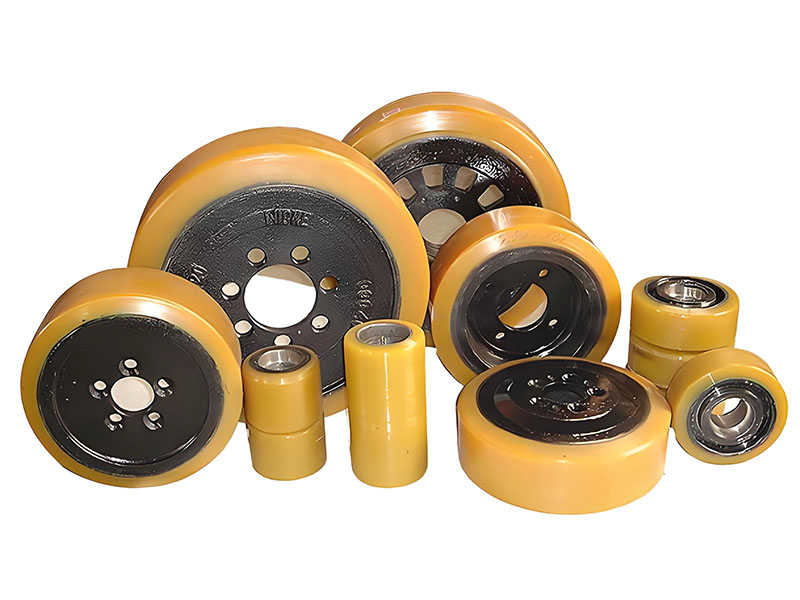
Selection suggestion: Choosing materials means choosing the total cost of ownership. Although the initial investment for polyurethane wheels is relatively high, based on actual data from YALIDE customers, their service life is usually more than three times that of rubber wheels under moderate strength conditions. In the long run, this actually significantly reduces the hourly usage cost.
Classified by structural design: technical codes for load-bearing and stability
1. Fully solid wheels
No inflation requirement, maintenance free, puncture resistant, is currently the mainstream design. The core difference lies in the internal structure: ordinary solid wheels may deform after long-term heavy loads, while high-quality solid wheels (such as YALIDE’s reinforced rib structure design) can maintain a long-term stable bearing surface through internal skeleton reinforcement.
2. Inflatable tires
Excellent buffering performance, suitable for outdoor uneven road surfaces. But there is a risk of tire blowouts and regular maintenance is required. In recent years, the advancement of solid tire technology has significantly narrowed the gap between the two in terms of shock absorption performance.
3. Shock absorber wheels (with cushioning structure)
Adding an elastic layer between the wheel core and the outer material can provide a shock absorption effect similar to that of pneumatic tires, while retaining the maintenance free advantage of solid wheels, making it particularly suitable for precision transportation scenarios with high requirements for cargo protection.
Selection key: Don’t just look at whether it is “solid”, but also consider the internal structural design. Excellent structural design can make the wheel load distribution more uniform and avoid premature local wear.

Classified by professional function: Value embodiment of scenario customization
1. Anti static wheel
Specially designed for environments sensitive to static electricity, such as electronics, chemicals, and pharmaceuticals. By using a special formula to control the resistance of the wheel body within 10 ^ 6-10 ^ 9 ohms, static electricity can be effectively conducted away. Important reminder: The anti-static performance will deteriorate with wear and tear, and regular testing is required.
2. High temperature/low temperature resistant wheels
Special wheel types for cold chain warehouses (as low as -40 ℃) or casting workshops (in high-temperature debris environments). Ordinary wheels may become brittle or soften at extreme temperatures, while special formula wheels can maintain stable performance.
3. Non marking wheel and ultra quiet wheel
For high-end warehouses, museums, hospitals, and other places with extremely high requirements for ground protection and noise control. These types of wheels are usually made of special colored polyurethane material to ensure no traces are left, while reducing rolling noise through structural design.
Deep insight: Functional wheels are not a luxury item, but a necessary risk management tool. The potential risk cost of using non anti-static wheels in explosion-proof environments or ordinary wheels in clean rooms is much higher than the procurement cost of special wheels.

Beyond classification: YALIDE’s solution philosophy
At YALIDE, we understand that simple classification is just the starting point for selection. The true value lies in:
Accurate matching: With a parameter database covering mainstream brands worldwide, we can not only follow the map, but also provide precise solutions for Chinese brand forklifts that are difficult to match due to frequent iterations, with “one vehicle, one strategy”.
Performance Fusion: We can integrate multiple functional requirements into one wheel, such as simultaneously meeting anti-static, low-temperature resistant, and seamless requirements, to avoid customers compromising on multiple standards.
Full lifecycle cost analysis: We provide customers with not only products, but also life prediction and total cost analysis reports based on actual working conditions, making every procurement decision data-driven.
Final selection suggestion: When choosing forklift wheels, please consider these three dimensions simultaneously: “Ground type determines material, load-bearing requirements determine structure, and environmental requirements determine function”. No matter how complex your needs are, YALIDE is committed to providing various brands of forklift wheels that not only match, but also bring positive improvements to your operational efficiency with perfect wheels.

YALIDE – The Forklift Walking System Expert Around You
We sell not only wheels, but also deterministic operational efficiency and computable long-term value.


 Monday to Friday 8:00-17:00







 Telephone:
  Email:
  whatsApp: