Deep within the mines, heavy-duty ore cars thunder along the tracks, each ton of ore transported testing the equipment’s endurance to its limits. The sharp clang of traditional metal wheels against rails, flying sparks, and frequent maintenance shutdowns were once unavoidable pain points in mining operations. However, the technological evolution of a critical component—polyurethane-coated wheels designed specifically for mining—is quietly transforming this landscape. These wheels equip heavy-duty transport equipment with “super-durable iron feet” that combine resilience, quiet operation, and extended longevity.
I. Core Application Scenarios in Harsh Environments
Polyurethane-coated wheels for mining are far from mere scaled-up versions of industrial wheels; they are bespoke solutions for extreme conditions. Their primary applications span the core arteries of mining production:

1. Underground rail car and locomotive wheel sets
Navigating inclined tunnels and complex curves, mine cars endure immense dynamic loads and impacts. Polyurethane wheels’ exceptional shock absorption significantly reduces rigid rail-wheel collisions, safeguarding track infrastructure and preventing premature rail head fracturing. Their high friction coefficient delivers reliable traction and braking on slippery surfaces, enhancing safety margins.
2. Guide and Auxiliary Wheels for Large Mining Dump Trucks (Articulated/Rigid)
These colossal vehicles traverse rugged off-road terrain. Polyurethane-coated press-fit wheels, serving as guide wheels and dump bed support wheels, withstand continuous abrasion from sharp rocks with outstanding cut and tear resistance. This prevents deformation and jamming caused by impacts that would affect metal wheels.
3. Conveyor Rollers for Crushing and Screening Stations
In dust-filled, high-vibration crushing and screening zones, conveyors operate at high speeds. Polyurethane rollers extend equipment lifespan in abrasive ore dust environments through superior wear resistance and noise reduction, while improving worker conditions.
4. Travel wheels and rollers for mining loading/unloading equipment
These machines require frequent steering and micro-movements. Polyurethane’s elastic deformation provides greater ground contact area and superior traction, reducing indentation damage to hardened surfaces while enabling smoother, more agile operation.
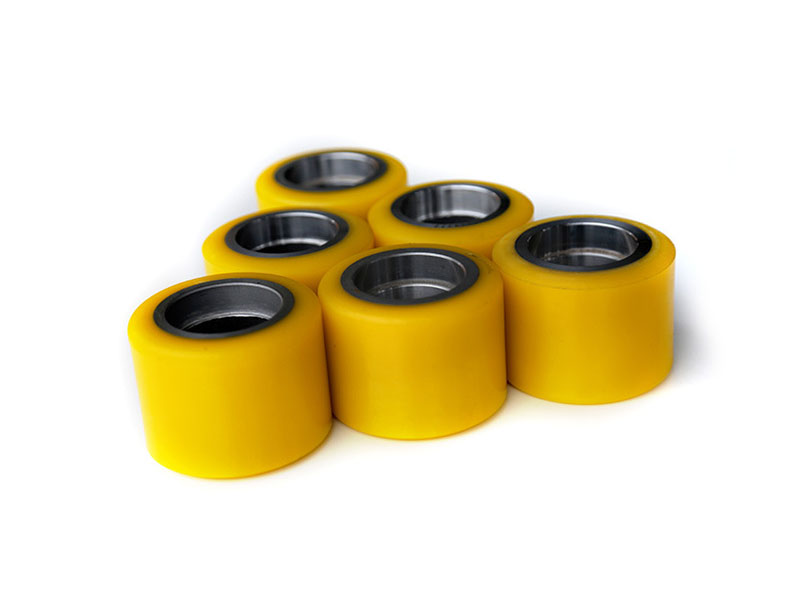
II. Performance Demands Surpassing Steel
Mining applications for polyurethane-coated wheels set extreme standards for material and mechanical properties:
1. Epic Wear and Tear Resistance
Mining wheels endure wear dozens of times greater than standard industrial environments. Specialized polyurethane formulations must incorporate unique reinforcements (e.g., ceramic microspheres, high-performance fibers), achieving an Akron abrasion value below 0.03 cm³/1.61 km—meeting the highest national standard. Tear strength often exceeds 120 kN/m, ensuring cracks resist propagation even when punctured by sharp ore fragments.
2. Thousand-Ton Load Capacity & Dynamic Impact Resistance
Single-wheel static load capacity often exceeds 20 tons. This demands not only high polyurethane hardness (typically Shore A 92A-98A) but also sufficient elastic modulus and rebound properties at high hardness to absorb massive impact energy during heavy downhill loads or sudden stops, preventing internal skeleton delamination or fragmentation.
3. Chemical Resistance and Wide Temperature Stability
Underground mine water may contain acids, alkalis, or oils. Specialized polyurethane must exhibit excellent hydrolysis resistance, mineral oil resistance, and moderate acid/alkali tolerance. Operating temperatures must span -30°C to 80°C, ensuring no brittleness in frigid shaft conditions and no softening under sustained friction-induced heat from equipment.
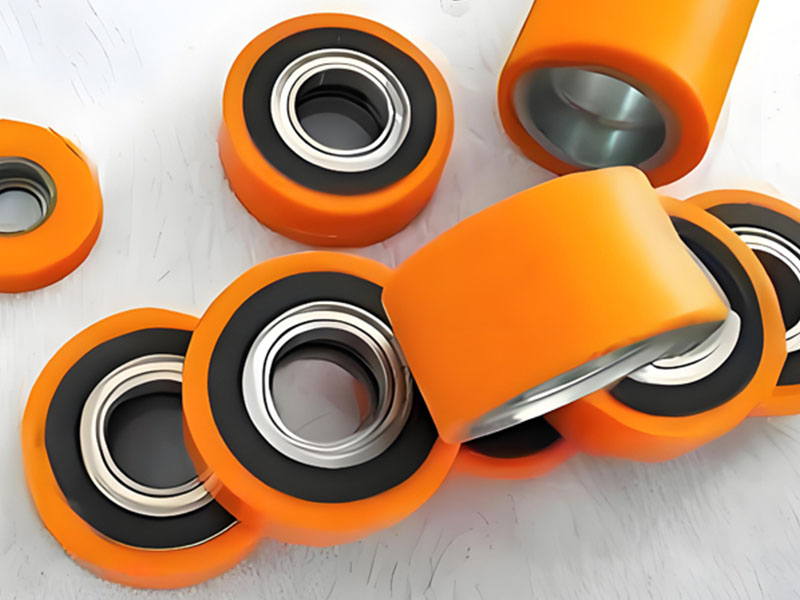
4. Precision-Engineered Press-Fit Structure
Press-fit is the core of safety. The bonding strength between the heavy-duty wheel’s metal core (typically alloy steel forgings) and polyurethane must be extremely high, achieved through a multi-groove dovetail structure + chemical bonding + high-temperature/high-pressure vulcanization process. Calculation of press-fit interference must be extremely precise to ensure zero play between the wheel and axle (or bearing) under massive alternating loads, eliminating safety hazards.
III. The Technical Path to Conquering Extreme Challenges
Applying polyurethane-coated wheels in mining environments is an ongoing engineering endeavor to overcome challenges:
1. The “Invisible Killer” of Heat Accumulation
During heavy-load, high-speed operation, polyurethane’s hysteresis heat generation effect causes rapid internal temperature spikes, potentially leading to thermal aging, sudden performance degradation, or even blowouts. The solution lies in innovative structural design: adopting hollow heat-dissipating structures, incorporating thermally conductive fillers into formulations, developing low-heat-generating high-performance polyether prepolymers, and strictly defining operational speed and load parameters.
2. The “Delamination Crisis” Under Extreme Loads
The interface between the metal core and polyurethane is a mechanical weak point. The countermeasure lies in **revolutionizing composite interfaces**: implementing multi-step pretreatment of metal cores through sandblasting, cleaning, and specialized primer coating; optimizing encapsulation structures via computer simulation for more uniform stress distribution; and employing transition layer technology combining polyurethane with epoxy resin to enhance bonding strength—ensuring the base material fails before interfacial delamination occurs.
3. “Material Dynamics” in Complex Environments
No single formulation suits all mines. Thus, customized materials science becomes critical. Wear-resistant types for iron ore, acid/alkali-resistant types for copper mines, low-temperature resistant types for frigid regions… Leading manufacturers build extensive material databases, collaborating with clients to develop tailored formulations through selecting prepolymers with different functional groups like MDI, NDI, and PPDI.
4. Balancing Lifecycle Costs and Efficiency
Though initial costs exceed steel wheels, overall benefits are substantial. The industry leverages digitalized lifecycle management to demonstrate value: embedding RFID tags in wheels tracks operational mileage and load history, predicting optimal maintenance and replacement windows to eliminate unplanned downtime. The resulting reductions in maintenance costs, energy consumption (through optimized friction coefficients), extended track life, and decreased noise pollution typically yield a lower total cost of ownership (TCO) compared to traditional solutions.
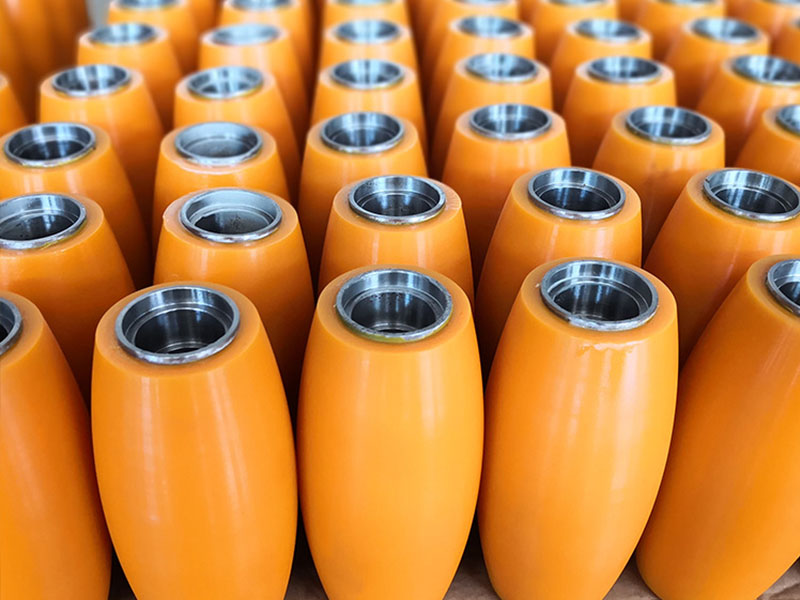
IV. Current Applications of Polyurethane-Lined Wheels
Today, in modern mines leading the charge toward intelligent and green transformation, polyurethane-lined wheels have become the unquestioned standard configuration for heavy-duty mobile equipment. They are no longer merely consumable parts but critical strategic components that enhance overall operational reliability, safety, and economics. Through silent yet resilient rotation, they support the efficient flow of hundreds of millions of tons of ore, spinning a song of endurance, ingenuity, and sustainable industrial innovation in the darkness of underground mines. Selecting the right polyurethane-coated wheels means choosing stronger ankles for the mining “behemoth,” paving the way toward a more efficient and safer future.
YALIDE Technology Co., Ltd. specializes in designing and manufacturing premium wheels. We consistently leverage our core competencies and market position to deliver high-quality services to our customers. YALIDE leverages material technology and engineering expertise to deliver value-added custom solutions, ensuring rapid prototyping, small-batch production, and automated mass manufacturing. Our custom services encompass material development, wheel design, welded wheel rim construction, tooling production, and testing. Replacing rubber components with polyurethane not only achieves superior wear resistance but also enhances efficiency, reduces costs, and delivers greater economic benefits for our clients.


 Monday to Friday 8:00-17:00







 Telephone:
  Email:
  whatsApp: