In modern factories, logistics centers, and commercial facilities, industrial casters serve as the foundational components for equipment mobility. From warehouse shelving to medical devices, from production line fixtures to heavy machinery, caster performance directly impacts operational efficiency, equipment safety, and operational costs. Among numerous material options, polyurethane wheels are emerging as the clear direction for industrial caster upgrades due to their systematic technical advantages.
Performance Comparison: Five Major Technological Breakthroughs of Polyurethane Casters
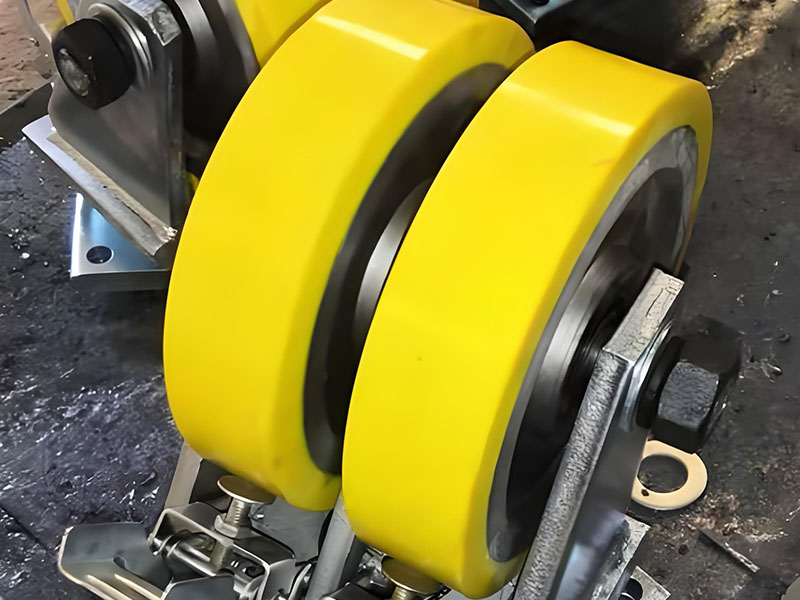
1. Revolutionary Enhancement in Load-Bearing Efficiency
Traditional nylon or rubber casters tend to deform under heavy loads, causing rolling resistance to surge dramatically. Polyurethane’s unique balance of hardness and elasticity enables a 30%-50% increase in load capacity for casters of the same size. For a 200mm diameter caster:
Standard rubber wheels: Dynamic load capacity typically ≤800kg
Polyurethane wheels: Dynamic load capacity exceeds 1200kg
This load-bearing advantage delivers significant value in automated material handling equipment and heavy-duty shelving systems.
2. Setting New Standards in Floor Protection
Modern industrial flooring represents substantial investment—epoxy flooring costs hundreds of yuan per square meter, while diamond-hardened surfaces are similarly expensive. Polyurethane casters’ low impression characteristics make them ideal for precision flooring: even contact pressure distribution prevents localized overloading; specialized formulations ensure no marks or staining. Test data confirms polyurethane casters cause only one-third the floor damage of rubber casters.
3. Geometric Growth in Wear Resistance
Under continuous operation on flat, hard surfaces:
Standard rubber wheels: 6-12 months
Nylon wheels: 8-18 months
Polyurethane wheels: 24-36 months
Though polyurethane wheels may cost 30%-50% more upfront, their over threefold longer lifespan reduces annual total costs by 40%-60%.
4. Energy Optimization Through Reduced Rolling Resistance
Polyurethane’s low hysteresis loss properties reduce rolling resistance by 25%-40% compared to traditional materials. For electric equipment, this translates to:
15%-20% longer battery runtime
Reduced motor load and lower failure rates
Over 30% less manual force required when pushing equipment

5. Comprehensive Environmental Adaptability
Through formulation adjustments, polyurethane wheels adapt to extreme conditions:
-40°C low-temperature resilience (cold chain logistics)
+120°C short-term high-temperature tolerance (foundry workshops)
Oil/weak acid/alkali resistance (chemical plants)
Silicone-free dust-free formulations (electronic cleanrooms)
Precise Application Scenario Matching
1. Automated Logistics Equipment
AGVs and material handling robots demand exceptional casters. Operational precision: Minimal polyurethane deformation ensures high positioning accuracy; Noise control: Operational noise ≤65dB, suitable for quiet environments; Maintenance cycle: Over 2 years maintenance-free, reducing downtime.
2. Medical and Laboratory Equipment
Requires silent, sterile, and precise movement; Ultra-quiet formula: Noise below 60dB; Sterility certification: Complies with medical device standards; Non-marking properties: Protects expensive laboratory flooring.
3. Heavy Industrial Applications
In steel, machinery manufacturing, and similar scenarios: High-load versions: Single-wheel load capacity up to 3 tons; Impact-resistant design: Adaptable to uneven surfaces; High-temperature resistant formula: Suitable for high-heat, debris-filled environments.
4. Commercial and Retail Sectors
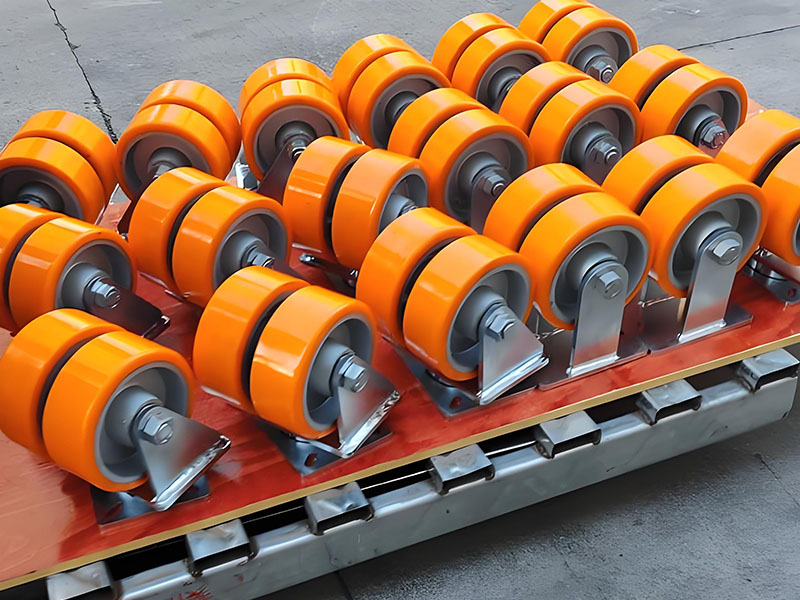
Requirements for shopping carts, display racks, etc.: Aesthetics: Multiple color options; Smoothness: Optimized pushing experience; Durability: Withstands high-frequency use.
Economic Considerations for Selecting Polyurethane Casters
Total Cost of Ownership (TCO) Analysis Model: TCO = Purchase Cost + Replacement Cost × Replacement Frequency + Downtime Losses + Energy Costs + Floor Maintenance Costs;
Case Study Comparison: An automotive parts factory’s transport cart caster upgrade project:
Before upgrade (rubber wheels): Replaced 3 times annually, with 80,000 yuan in floor repair costs.
After upgrade (polyurethane wheels): Replaced once every 3 years, zero floor maintenance.
Payback period: 8.6 months.
YALIDE’s Professional Solutions
Based on deep understanding of industrial applications, YALIDE provides:
1. Operational Condition Diagnosis Service
Floor Type Analysis: Roughness, hardness, material testing; Usage Intensity Assessment: Average daily travel distance, load variations; Environmental Factor Consideration: Temperature/humidity, chemical exposure.
2. Technical Matching System
Database of 200+ formulations; Intelligent recommendation algorithm; 3D simulation validation.
3. Verified Testing System for Every Product:
Dynamic Fatigue Testing: Simulates 1 million cycles under real-world conditions;
Environmental Adaptability Testing: High/low temperature and chemical resistance validation;
Surface Compatibility Testing: Practical evaluation on diverse flooring materials.
Emerging Industry Consensus
Polyurethane is not merely an “alternative material” but the “inevitable path” for upgrading industrial caster performance. With advancements in material technology and scaled production, its cost-performance advantages will become increasingly evident.
Choosing polyurethane wheels represents not just a product upgrade, but a strategic investment in operational efficiency, equipment safety, and long-term cost savings. Against the backdrop of Industry 4.0 and intelligent transformation, this seemingly minor component selection often determines the reliability and economics of entire material flow systems.
YALIDE’s Commitment: We deliver not just polyurethane wheels, but **optimal mobility solutions** tailored to your specific operating conditions. From technical consultation to validation testing, from product delivery to post-implementation optimization, we dedicate ourselves to making every piece of equipment move more efficiently, economically, and reliably.
Let Mobility Create Value
Choosing polyurethane wheels means choosing a smarter, more economical, and more sustainable approach to industrial mobility.


 Monday to Friday 8:00-17:00
 YALIDE >
News Content>Industry News> Why Polyurethane Wheels Are the Preferred Choice for Industrial Casters
YALIDE >
News Content>Industry News> Why Polyurethane Wheels Are the Preferred Choice for Industrial Casters 





 Telephone:
  Email:
  whatsApp: